Projects
I love building and using telescopes. To that end, I have developed my own tools and techniques. Detailed here are the projects I've decided to pursue, and tools that have made them possible.
My telescopes
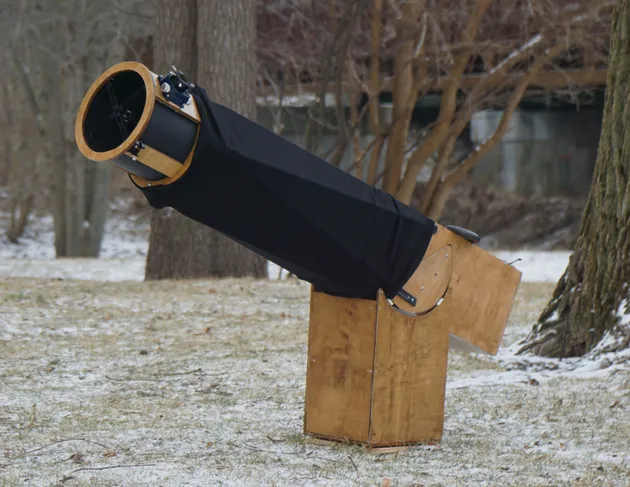
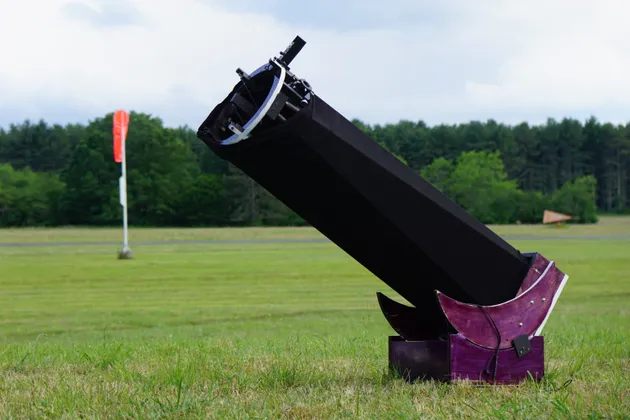
At right are my telescopes, an 8 inch f/8.4 that I built in 2021, and my 12" f/5 I built in 2022. I have built a couple smaller examples, but these are the flagships. Both sets of optics were purchased. In the case of the 8 inch, it was figured by an unnamed amateur in the southern US in the 80s.
I work on primary mirrors myself. At time of writing I'm working on three- a 6 inch f/2.9, a 6 inch f/7, and a 14 inch f/4.5 for a friend. I was fortunate to have been virtually given a mirror grinding machine, so a lot of the caveman work is done for me! It still takes many hours, but I get to sip coffee while it happens.
Beyond the telescopes themselves, I have made and utilized a small array of well-known testing methods for newtonian optics, which measure certain qualities and help to characterize the abberations inherent to an optic.
Concave Mirror Testing
I utilize a small battery of optical tests to characterize the performance of a primary mirror during grinding and figuring. Limitations and errors abound in any kind of optical measurement, but there are several obvious standouts for amateur telescope makers like me. These are Ronchi/Diffraction-Grating, Foucault/Knife-Edge, and Bath Interferometry.
Ronchi Grating
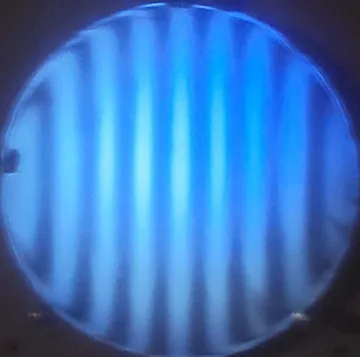
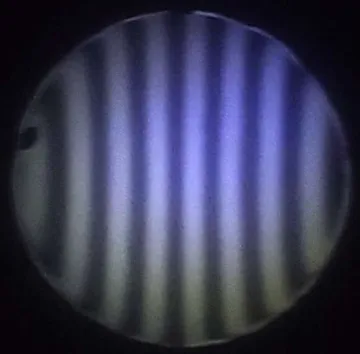
Here are some notable "ronchigrams" that I have personally taken. A ronchi test in this configuration is a spherical null test, meaning it shows straight lines when the optic has a spherical curve. It is a forgiving test layout that can be done with only a cell phone and grating, taking just a few seconds to get a meaningful result.
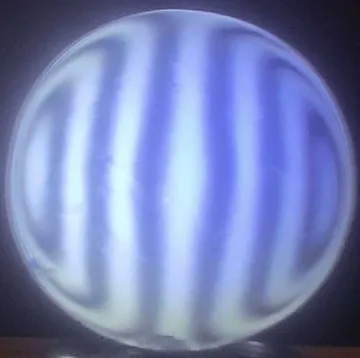
These ronchigrams are of the same mirror, a 6" f/2.9. The top left notably has an error called "turned down edge", where the edge of the concave curve drops sharply near the edge. This is contrasted by the image below it, which has minimal turned down edge and is nearly ready for parabolizing.
On the right is something more severe- a rolled edge present at an earlier polishing stage. This takes a long time to address!
A ronchi test is excellent for identifying these problems quickly and clearly. Getting straight lines, the spherical null, is the goal. Once you're there, you can start parabolizing.
Foucault (Knife Edge)
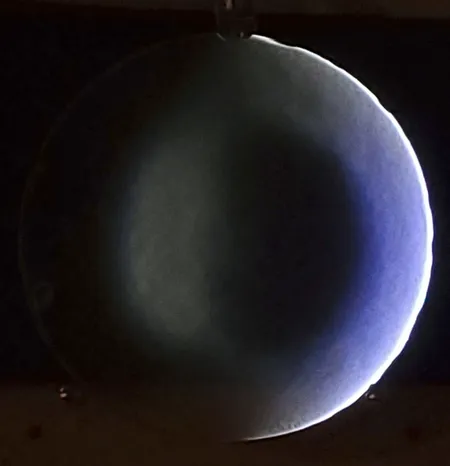
A foucault shadowgram is an excellent test to characterize a spherical mirror, and when used with a mask can determine the quality of a parabolic correction.
Like the Ronchi test, it is an inexpensive and relatively accessible way to test a mirror, but offers a more granular resolution than ronchi alone. It is especially sensitive to surface roughness and its position relative to the focal point of the mirror. On the right, it looks like there are bumps across the optic- this is a real image of surface roughness. The optic feels smooth to the touch, but foucault shows bumps that are nanometers in height!
With sensitivity comes drawbacks, as it demands a more complicated test setup than the ronchigram. Because of this, it's excellent to either achieve an extremely accurate final reference sphere, or used to determine parabolization correction of a final optic.
Interferometry with a Bath Interferometer
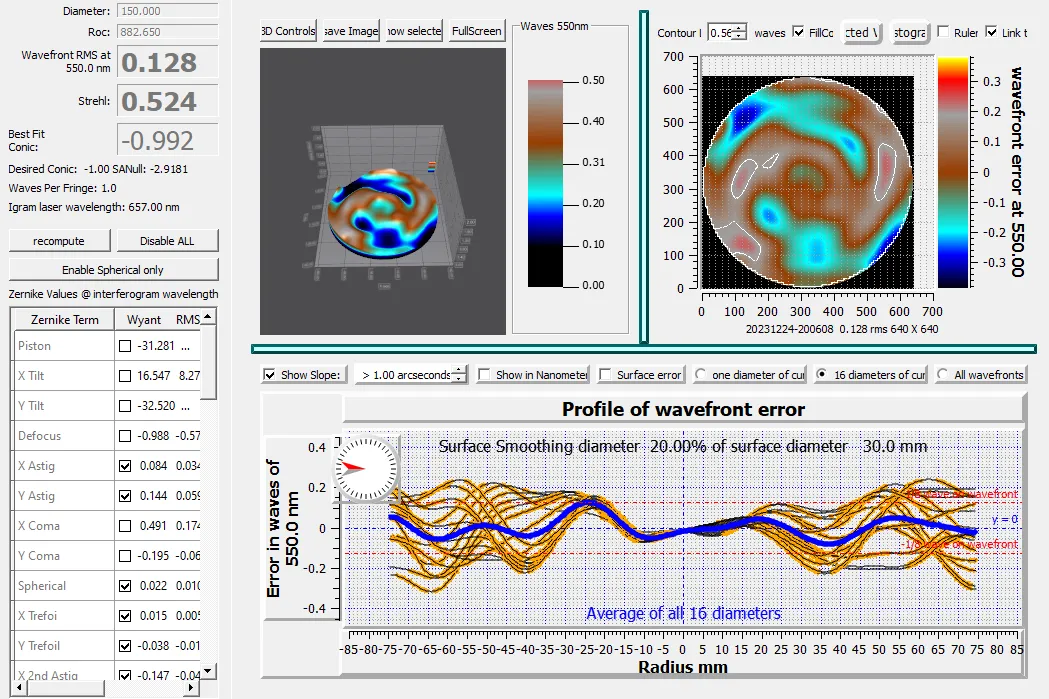
The most complex tool I use is a Bath Interferometer. This device uses a laser to produce interference fringes which are compared to a virtual null. It requires the most time, and the most practice, but provides an accurate and quantitative result that helps to characterize the optic. It is especially useful to determine if the optic has astigmatism, which is an all-too-common plague among amateur made mirrors.
An interferogram and subsequent interpretation from a computer program like DFTFringe allows you to see the measured output "Zernicke Polynomial decomposition"; in laymans terms, it outputs a model for the real surface that was measured. One of the polynomial outputs, say, would describe one axis of astigmatism. This is incredibly powerful, but requires the most oversight and discernment- it is easy to unintentionally alter the results at every stage of the process.
With patience, and time, it is the most fun- the output results can be shown graphically in any number of ways. This is an excellent way to demonstrate that an optic is quantitatively what you say it is- so long as you're honest!